Where does Melanoma most often metastasize?
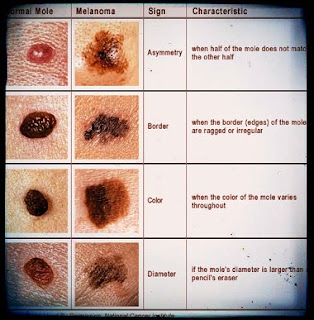
What is malignant melanoma? Malignant melanoma is a less common form of skin cancer . When diagnosed early, it is easily cured. But if it is not found soon enough, it can be very difficult to treat. It is dangerous because, unlike the other skin cancers, it mestastasizes early and spreads quickly. It is one of the more uncontrollable cancers. The cell involved is the melanocyte, the cell which produces melanin, the dark protective pigment of the skin . What is the difference between an ordinary mole and melanoma? An ordinary mole is evenly colored, and either brown, tan or black. It may be flat or raised. It is round or oval and its edges are sharply defined. An ordinary mole is usually less than 6 millimeters in diameter about the size of a pencil eraser. Ordinary moles may be present at birth. Sometimes several appear at the same time, usually on areas of the skin which have been exposed to the sun. Once the mole develops, it usually stays the same size, shape and color for ma...





Comments
Post a Comment