Posts

Showing posts with the label treatment

Where does most tongue cancer occur: Symptoms, Red or white patches and Treatment

Image
Who is at high risk to get cancer of the tongue? Cancer of the tongue appears mostly in men who are over 40 although the proportion of women with tongue cancer is increasing, probably because of increased alcohol and tobacco use. Where does most tongue cancer occur? Most cancer of the tongue is situated at the tip or along the side of the tongue. It can usually be discovered early. What are the symptoms of tongue cancer? You might see deep red patches. Sometimes there are white patches. Sometimes the deep red patches turn bluish white. This is called leukoplakia, which represents an overgrowth of cells. There may be only a few spots or they may be on the whole tongue. Sometimes they will not hurt. They may be irritating and uncomfortable. The greatest danger of these patches is that if they are not treated, some of the area might turn into cancer. Some people complain of pain, which they usually think is a sore throat. It gets worse when they talk and swallow. Sometimes t...

Floor of the mouth cancer: Diagnosis, Metastasize, Treatments and Signs

Image
How is cancer of the floor of the mouth diagnosed? The doctor will look at and feel the tumor. He will take xrays and do a biopsy to confirm the diagnosis. Does cancer of the floor of the mouth metastasize? Yes. This is one of the oral cancers which metastasizes to the lymph nodes in the neck in a good number of patients. What treatment is used for cancer of the floor of the mouth? In early stage cancers, the treatment is usually radiation or surgery. Cancers that are more advanced are usually treated with surgery followed by radiation and sometimes chemotherapy. How the disease progresses cannot be predicted. This depends, among other things, on how fast and aggressively the cancer grows and how big it is. Small, localized tumors can either be operated on or irradiated by doctors. With more advanced cancer, the operation is often supplemented with radiation or radiation chemotherapy. The treatment also depends on the personal needs and the physical condition of the perso...

Cheek Cancer Metastasize: Symptoms, Risky Peoples, Diagnosis and Treatment

Image
Who is at high risk for cancer of the cheek? Cancer of the inside of the cheek (sometimes referred to by doctors as buccal mucosa) occurs more often in males over the age of 55. It is believed that persons who chew tobacco and betel nuts or who bite their cheeks are at a higher risk of getting cancer of the cheek. What are the symptoms? The symptoms include a sore inside the cheek which does not heal, bloody saliva, and white patches inside the cheek. There is usually no pain. Does cancer of the cheek metastasize? Cancer of the cheek is usually slow growing. It also has a relatively low rate of metastasis. How is cancer of the cheek diagnosed? It is diagnosed by direct inspection and feeling by the doctor. Final diagnosis is by biopsy. How is cancer of the cheek treated? Early stages ofcancer ofthe cheek are treated with radiation or by surgery. Advanced cancer of the cheek is treated by surgery, followed by radiation and sometimes chemotherapy.

Oral(Mouth) Cancer: Symptoms, Bleeding, Treatment and Diagnose

Image
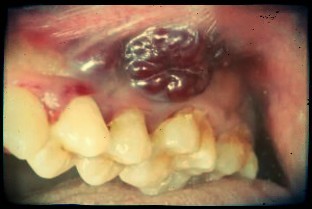
What kinds of cancers are found in the mouth? The cancers of the mouth (oral cavity) include the lip, tongue, floor of the mouth, cheeks (buccal mucosa), and gums (gingivae). Who is at high risk to get cancer of the mouth? This cancer is predominantly found in men between the ages of 60 and 70. People who are heavy smokers (more than a pack a day), drink alcohol heavily, are over 45, and have a family history of this kind of cancer are at a higher risk to develop cancers of the oral cavity, the mouth, and the throat. Is cancer of the mouth easy to detect? Yes, it is usually discovered early, since it can be seen easily. White patches ( leukoplakia ), velvety red spots (erythroplasia), or dark patches are symptoms which should be seen by a doctor, who will do a biopsy of them. Many cancers of the mouth are first discovered by dentists. What are the symptoms of oral cancer? The warning signs of oral cancer are as follows: • A lump in the cheek that can be felt with the ...

What is cancer of the oropharynx : Diagnosed , Symptoms and Treatment

Image
What is cancer of the oropharynx? Cancer of the region of the oropharynx includes the soft palate, tonsil, walls of the pharynx, and back third of the tongue. The most common site for this cancer is on the tonsil . Oropharyngeal epithelial cell carcinoma refers to cancer of the tonsils, the bottom and posterior third of the tongue, the taste bud , and therefore the posterior and lateral pharynx. epithelial cell carcinoma comprises quite 95% of oropharyngeal carcinoma. Tobacco and alcohol are important risk factors, but human papillomavirus (HPV) today causes most of those tumors. Symptoms include pharyngitis and painful and / or difficult swallowing. Treatment is with radiation, chemotherapy , or both, but primary surgery is becoming more common. The survival rate is far higher in HPV-positive patients. As with most head and neck cancers, non-HPV-related oropharyngeal cancer is more common in older men with a mean age of 61 years. Tobacco and alcohol remain the main risk facto...

Cancer of the Hypopharynx: Early Symptoms, Treated, Metastasis and Detect Cancer

Image
What is cancer of the hypopharynx? Cancers of the hypopharynx are tumors of the lower pharynx. They are found mostly in males from the ages of 49 to 60.Hypopharyngeal carcinoma may be a malignant neoplasm within the area of the hypopharynx (lower pharynx). Hypopharyngeal carcinoma may be a sort of laryngeal carcinoma. Alcohol abuse and nicotine abuse especially together favor the event of hypopharyngeal cancer. Furthermore, occupational exposure to metal dusts, coal and tar products, and asbestos cement are often carcinogenic. Poor oral hygiene, which results in a pathological composition of saliva, may be a risk factor. Hypopharyngeal carcinomas are usually moderately differentiated epithelial cell carcinomas. Piriform sinus carcinomas often have a submucosal spread pattern and show only the "tip of the iceberg" in . There are three clinical regions of the hypopharynx: Piriform sinus (approx. 90%) Posterior throat wall (approx. 5%) Post-cricoid region (app...

Salivary gland tumors: How to treat, symptoms and after operation.

Image
Where are the salivary glands? The major salivary glands are in the sides of the face, in front of and slightly below the ears. These salivary glands are also known as parotid glands . The saliva gets from these glands to the mouth through parotid ducts, which open on the inner surfaces of the cheeks. There is also a pair of glands in the lower jaws (submandibular glands) and under the tongue (sublingual glands). The ducts from these glands open into the floor of the mouth underneath the tongue. Where are tumors of the salivary glands found? Tumors of the salivary glands are most often found in the parotid glands. Most often these tumors are not malignant. They are either on the outer surface of the parotid gland, which is near the ear, or in the inner surface, which is in the mouth. Benign parotid gland tumors are usually painless and slow growing. Malignant tumors ofthe parotid tend to grow rapidly. Sometimes a tumor seems to be benign for many years and then suddenly becom...

Cancer of the Penis: Usual Treatment, symptoms, metastasis and sexual problems

Image
Does cancer of the penis ever occur?  Cancer of the penis is quite rare. It usually occurs on the tip of the penis and is almost exclusively found in uncircumcised males between the ages of 50 and 70. In others, cancer of the penis is found to be a metastasis from the bladder, prostate , lung, pancreas, kidney, testicle , or ureter. What symptoms should alert a man to the possibility of cancer of the penis?   A pimple or sore, small nodule, white thickened patches, raised, velvety patch, wart or ulcer especially a painless ulcer are all suspicious symptoms. Bleeding associated with erection or intercourse, persistent abnormal erection without sexual desire, foul smelling discharge, or a lump in the groin should all be carefully investigated. What is the usual treatment for cancer of the penis?  The usual treatment is surgery. Approximately 90 percent of patients with cancer of the penis, if it is found in the early stages, will be cured through the surgical re...