Posts

Showing posts with the label orthopedic

How to know if your ankle is broken? How is a broken ankle treated?
Image
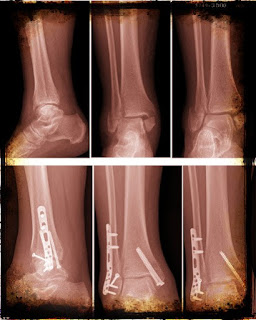
Fractures of the Ankle How do ankle fractures occur?  Ankle fractures are caused by a forceful and excessive twisting of the ankle , either in or out. The twist comes from stumbling, catching the foot in a crevice, or falling, in which the weight of the body is unevenly distributed. Many skiers suffer fractured ankles, and some of the best treatments have been evolved by surgeons practicing near ski slopes. The stress and strain factors in the ankle are so uniform that the pattern of the injury, dislocation and deformity is specific. Many varieties of ankle fractures are grouped together under the name of Pott's fracture. What shall I do, Doctor? I'm at a gas station phone and my wife just fell down and twisted her ankle.  If it is painful and she can't walk, it may be a fracture. Don't manipulate it, don't pull it. Just wrap a towel or pillow around it and take her to a hospital for an X ray. It is best if she does not walk. You can carry her in a chair. ...

How is a fractured hip treated? How long is recovery for hip replacement?

Image
Hip Fractures Why are hip fractures so common in elderly people?  The cause is not known. Many patients will say that they sustained the fracture by falling, stumbling or tripping. There is a high probability that the fracture occurred first and the individual fell, stumbled or tripped because of it. Patients have been known to turn over in bed and fracture a hip. Hip fractures have a direct correlation with stresses and strains associated with alteration in the bone structure and blood supply associated with aging. On home consultation, how can you be so sure, without an X ray, that the hip is fractured?  Home consultation can show the characteristic deformity of a fractured hip. The ankle is turned out; on direct measurement this leg is now shorter than the opposite one; there is severe pain in the groin and on motion of the hip; and the heel cannot be raised off the bed. An X ray of course is still necessary, for it is possible to have a fractured hip in which th...

How do you know if your wrist is fractured? How is a fractured wrist treated?

Image
Wrist Fractures I felt myself slipping and stretched my arm out for support. Now my wrist is swollen and painful. Is it broken?  Symptoms of pain, swelling and deformity are characteristic of a fracture. However, this impression should always be supported by an X ray. This X ray shows a fracture of the lower end of the forearm, an injury so common that it is called a Colles fracture after one of the early bonesetters. What should be done about a wrist fracture and when?   This fracture is best treated as soon after the injury as reasonable and certainly before there is marked swelling and muscle spasm. Under ordinary circumstances, the patient need not stay in the hospital after the bone has been manipulated back into position and a cast applied. The entire procedure can be painlessly accomplished by injecting a local anesthetic into the fracture site. Why do you take another X ray after you set the wrist fracture? How long will this cast be on? What does the cast ...

How is a broken or cracked rib treated?

Image
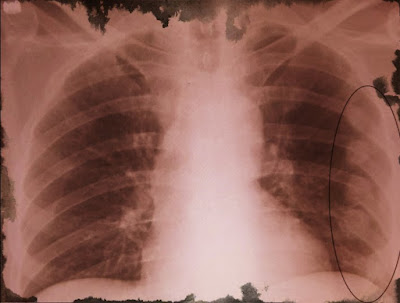
Chest Injuries The chest consists of the bony thorax and the organs that lie within it. The thorax comprises twelve ribs on each side of the chest, each of which attaches to the bony spine in the back and to the chest bone ( sternum ) in front. Each chest cavity has a smooth delicate lining ( pleura ) within which the lung rhythmically expands and deflates. The diaphragm is the dome shaped muscle that seals off the lower end of the chest from the abdomen. Its upand down motion provides the bellows action for the expansion of the lungs that fills them with air. The function of the lungs is to provide ventilation. Air is moved in to provide oxygen, and carbon dioxide is moved out as a waste product. The heart is in its own envelope in the center of the chest, behind the breastbone. The heart functions solely as a pump. It circulates the blood into the lung for oxygenation and delivers oxygenated blood to the entire body. The chest also harbors the large blood vessels and the br...